
Navigation
Bridgewater Bridge Underslung Gantry
Client: IPD Engineering & Consulting
End Client: TasWater
Contractor: McConnell Dowell
Structural Engineer: Collective Consulting
Pipeline Engineer: IPD Engineering & Consulting / Beca
Key Personnel: Alan Leake (Principal Structural Engineer), Christopher Polis (Research Engineer), James Weeding (Structural Modeller)
Completion: 2025
Estimated Construction Value: $20,000,000
1.1 Kilometre Services Gantry for Water and Sewer Infrastructure
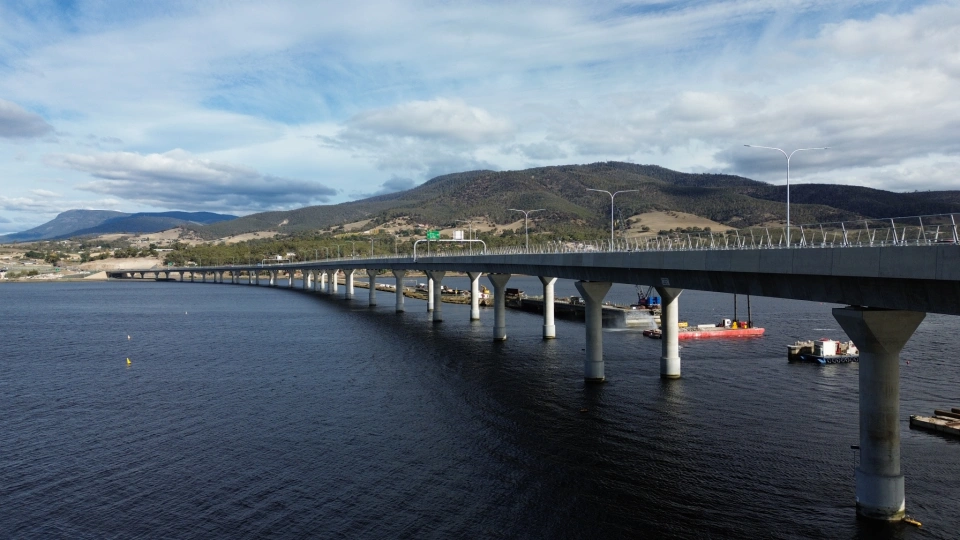
The Bridgewater Bridge in Hobart has been built by McConnell Dowell for the State of Tasmania to replace an old bridge completed in 1946, a steel and concrete lift span bridge, linking this critical waterway between the north and south. IPD Consulting engaged Collective to provide comprehensive structural engineering design, documentation, and certification for an underslung gantry proposed beneath the bridge deck for TasWater. This critical infrastructure was to support TasWater services including large-scale sewer and water trunk mains essential for suburbs and townships on both sides of the Derwent River.
The 1.1 kilometre steel gantry design accommodates a network of pipelines and a maintenance walkway, facilitating safe access for TasWater personnel. The design incorporates two tower structures at each bridge end and a monorail spanning the entire facility for maintenance operations. The project required sophisticated coordination between multiple stakeholders including TasWater, bridge engineers, pipeline designers, and construction contractors.
Engineering Challenges
- Bridge Thermal Movement: The gantry's attachment to the bridge deck required connections accommodating longitudinal thermal expansion and contraction of the bridge structure while maintaining structural integrity and construction tolerances.
- Multi-Material Pipeline Dynamics: The gantry carries pipelines of varying materials, mild steel, ductile iron, and plastic, each exhibiting divergent thermal expansion characteristics. Operational forces and temperature variations created complex load cases requiring careful management at the services gantry and bridge junction.
- Corrosion Protection: Industrial coating specialists recommended protective systems ensuring a 40-year design life with maintenance considerations, accounting for the aggressive environment beneath the bridge and differing material longevities.
- Load Coordination: Critical transmission of load data between gantry designers (Collective), bridge designers (Tony Gee), and pipeline engineers (Beca/IPD) ensured all loads remained within bridge design specifications while accommodating pipe longitudinal and lateral forces.
- Tower Entry Systems: Two tower stair entry gantries with monorail access at each bridge end required separate foundation designs and assessment of interactions with bridge abutments.
- Differential Movement: Geotechnical reviews ensured foundation designs accommodating differential movements between the gantry stair structures and adjacent bridge infrastructure.
Structural Design Solutions
Collective Consulting advanced the initial feasibility concept, steel channels and gratings, into a robust steel frame structural system. The design employed connections allowing longitudinal movement to address thermal expansion and accommodate construction tolerances. Collaboration with McConnell Dowell determined appropriate attachment methods for integrating the gantry into the existing bridge structure.
The 3D structural engineering documentation utilised curvature and Revit models from the bridge design team, producing a sophisticated 1.1-kilometre 3D structural model. The model incorporated all relevant pipe loads, gantry loads, and Beca pipeline loads through detailed analyses. Foundation designs for stair structures at either bridge end were developed with careful consideration of abutment interactions.
Safety integration included walkway design with safety mesh and floor systems, monorail structure interaction with piping infrastructure, and lighting design coordination. Comprehensive basis of design submissions supported stakeholder review alongside detailed load assessments for services gantry, pipeline, and bridge elements.
Coordination and Documentation
Constructability workshops facilitated collaboration among TasWater, proof engineers, design-build professionals, and regulatory authorities. IPD led the services gantry design with Collective Consulting delivering structural engineering, detailed drafting, and documentation. IPD managed pipe loading parameters and implemented air valves to mitigate load impacts while resolving pipeline-structure interface issues.
Quality assurance encompassed geotechnical reviews, corrosion assessments, accurate ferrule location and installation coordination with bridge contractors, and prompt response to client queries with detailed calculations as required.
Project Status
While TasWater elected not to construct the gantry during the bridge construction process, provision for its addition at a later date has been made. While the underslung gantry design remains a well-engineered solution, alternative approaches including buried pipelines are currently under consideration as potentially more viable implementations. The comprehensive design and detailing completed by Collective Consulting ensures the gantry structure remains a robust option should project direction support its future realisation.
Key Outcomes
- 1.1-kilometre 3D structural model integrating bridge curvature, gantry framework, and pipeline infrastructure.
- Sophisticated thermal movement accommodation managing bridge, gantry, and multi-material pipe expansion differential.
- 40-year design life corrosion protection system specified for aggressive underslung environment.
- Comprehensive load coordination ensuring bridge structural integrity under combined service loads.
- Detailed constructability documentation and safety-integrated walkway and monorail systems.
This project exemplifies the complex coordination required for infrastructure serving critical utilities across major river crossings, balancing structural performance with long-term maintenance accessibility.